
Free website Templates, Cheap- damage your Reputation

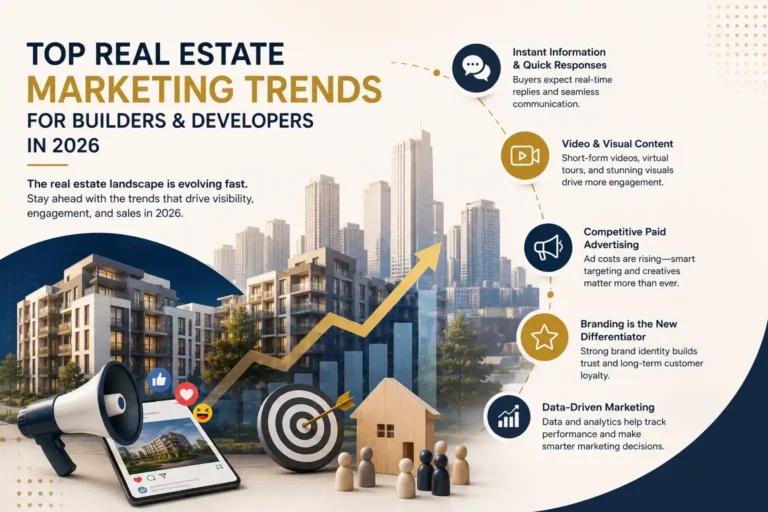
The real estate industry is day by day it is increase unexpected speed, and what used to work last year will not suffice this year. Consumers have grown smarter, and competition is heavy in the industry. In addition, it takes a lot more to capture people’s attention these days, and branding of the company is not that easy.
By 2026, construction companies and developers must not rely solely on outdated marketing techniques. Every aspect of consumer behavior regarding searching, comparing, and purchasing property has changed, and the users’ viewpoint has been changed and undergone a drastic shift towards becoming digitally-led. Social media power, influencer marketing, and running the ads are performing and giving the proper results, and data-centric campaigns are some of the latest trends in modern marketing. Relying exclusively on traditional tactics such as listings and brokers is not enough to give only the ground-level reach of the audience. Real estate marketing in the present era revolves around generating demand and guiding consumers toward conversion.
Here is what is changing fast:
Go through the content below to understand how these trends can help you grow faster and sell smarter.
The brand trust factor has become crucial when making purchasing decisions nowadays, and it has become the most important for the real estate industry. People tend to buy from brands that they trust and know are of the best quality, and assurances that they check the background verification. Branding becomes an essential part for developers in 2026 because it will allow them to grow their businesses. Get noticed and give a unique thing in people’s minds.
Visibility is not what real estate marketing should be anymore. Marketing should be all about getting results what we planed it has be in the work. In 2026, developers have switched their attention from campaigns that are visible to campaigns that deliver results. Previously, success was calculated through the number of leads generated. However, the focus has changed to conversions, site visits, and bookings. Developers are able to increase their return on investment through these methods. The basics of a performance setup include tracking, conversions, and optimization. The agency analyses data each day to optimize the performance of the leads.
Go anywhere in the world of marketing for real estate in 2026, and you’ll hear – “We need reels.” And yes, that’s right. The short-form video is no longer a luxury – it is the way properties are discovered today. If it’s an Instagram Reel capturing the view from a flat during golden hour or a YouTube short taking a tour of an amenity deck, buyers are putting things on their shortlist before even meeting the sales teams.
And here’s why that works brilliantly for the real estate sector. Property decisions are visual ones; buyers want to experience the property before visiting it. Good video content allows them to do that while remaining completely unselling. Videos inspire aspirational emotion in buyers, which in turn means inquiries for site visits for builders.
What builders got right. Smart developers aren’t wasting lakhs of money on a single-brand video anymore. Instead, they are building a content calendar featuring videos with construction updates on the ongoing projects to show the reality and trust, tours of the neighborhood, customer testimonials, and behind-the-scenes looks. All of this ensures that your buyer’s imagination stays invested in your property. Do you have a content calendar for regular video production for your project?
Getting 100 leads is not useful if none of them convert or if they are junk leads. That is why in 2026, the focus is shifting from quantity to quality, as getting more leads is not the requirement, targeting the exact audience is required. Developers are now targeting high-intent buyers based on the project’s requirements. These are people who are actively looking to buy and are closer to making a decision, and location-exact-based targeting.
Agencies use smart targeting techniques like search intent, age-based, users’ income-based, behavior tracking, and retargeting to find these users. This reduces follow-up time and improves conversion rates. Landing pages are also being optimized to filter serious buyers. Instead of collecting basic details, forms are designed to understand budget, timeline, and preferences. This helps sales teams focus only on serious prospects.
Generic advertising and communication have failed. Customers need tailored communication. It has become common practice for developers to use data to tailor their communication. This includes personalizing their emails and messages based on customers’ needs. A customer interested in buying luxury villas will see very different ads from a customer looking for low-cost apartments. The interaction of the users has changed.
This is a number every sales leader in the real estate industry will have nightmares about – the average response time to an inquiry in India’s real estate sector stands at over four hours. In today’s fast-paced world, when a potential client sends the same inquiry to five projects, the project that responds within two minutes gets the sale. With an AI-enabled CRM, you can achieve all of this without even lifting a finger.
The advanced CRM software for real estate, coupled with AI technology, can send a personal message via WhatsApp to the lead who just filled the form, automatically allocate the lead to a specific sales representative depending on location and budget, and rate the leads based on page visits and time spent on the website. All this is not science fiction; builders who use such a CRM system see a 30%-40% improvement in their lead-to-visit ratio simply by improving their response time.

we help create the brand experiences of the future through a creative culture rooted in entrepreneurship and partner collaboration.
Address
407, 2nd Main Rd, B Channasandra, Kasturi Nagar, Bengaluru, Karnataka 560043
Phone




© 2026 Kleverway, Bangalore.
WhatsApp us
