Best CMS Website Platforms for Business Growth in 2026
Recent Posts
Introduction – Why CMS Choice Decides Business Growth in 2026
In the year 2026, the Content Management System is not only about publishing web pages. It is now the main engine for the growth of modern businesses.
The choice of CMS today influences the speed at which your site loads, its search ranking factors, the effectiveness of your marketing team, and the scalability of your business.
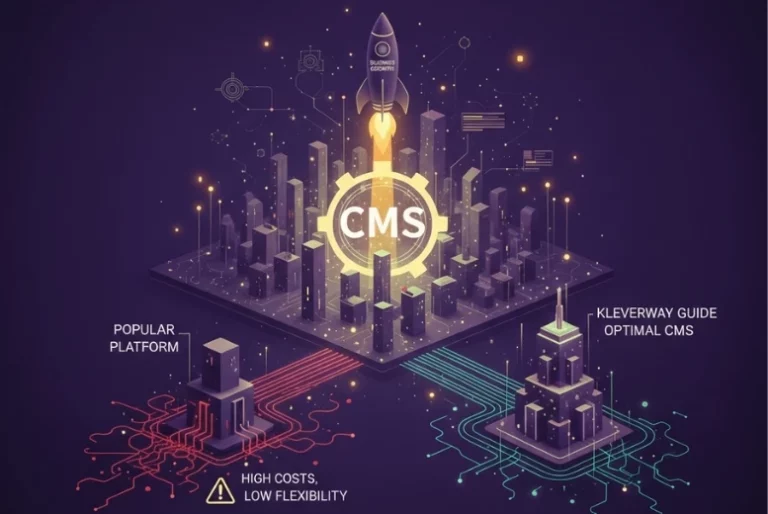
However, most organizations today tend to make their choice based on the most popular CMS platform option. With the increasing competition in the digital world, using the wrong CMS website platform can result in low flexibility and high maintenance costs in the future.
This is no way a comparison of features and a list of pros and cons. It is a help and a guide. This is a guide written by Kleverway. It is written with a view to finding the best CMS website system that would help a business grow in 2026.
How We Evaluated CMS Platforms for Business Growth
Selecting a CMS in the year 2026 will not be about identifying which CMS has the most features available. It will focus on identifying which system will best complement your business growth plans and overall objectives.
Kleverway has experience in dealing with projects in the fast-paced world of startups and enterprises. We have observed some general trends over the years. The same CMS may be an excellent choice for one business but quite an expensive error for another.
Rather than examining similarities in surface-level characteristics, we have assessed each CMS with five growth-oriented questions:
1. Can this CMS scale with your business?
2. How friendly is it for marketing teams?
3. How flexible is the platform over time?
4. What is the true long-term cost?
5. Can non-technical teams work independently?
Such a framework will allow startups picking their first CMS as well as enterprises deciding on their next platform shift to make smarter decisions about the future.
How We Evaluated CMS Platforms for Business Growth
There is no one-size-fits-all CMS.
The right platform depends far more on your business model than on how popular a tool is.
Content-Driven Businesses
For blogs, publishers, and SaaS marketing pages, the factors that drive growth are SEO, speed to publish, and editorial processes. Such sites require CMS tools that empower their content teams to work quickly and independently.
E-commerce and D2C Brands
For e-commerce sites, the CMS affects their revenues in a direct manner. The functions of performance, payment process, availability, and marketing automation are of utmost importance in this regard, as an inappropriate CMS can result in reduced sales.
B2B and Lead Generation Companies
For B2B companies, the site acts as a lead machine. The CMS needs to support landing pages, CRM integration, personalisation, and strong sales alignment.
Enterprises and Multi-Channel Brands
Selection of the CMS is a platform strategy for large organizations. In this case, multi-site management, governance, security, and omnichannel delivery become the primary focus of attention.
Knowing your business type is the foundation of making the right CMS decision.
Platform Deep-Dive – How Each CMS Supports Growth
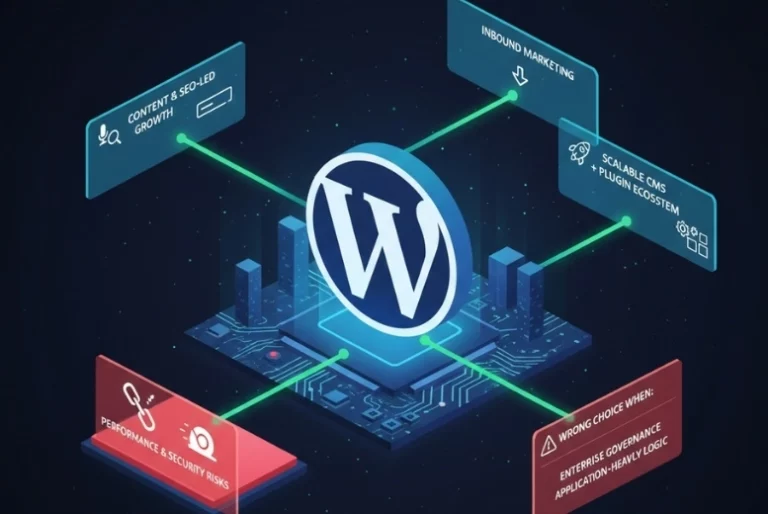
1. WordPress – Content and SEO-Led Growth
- Best for: Content-heavy businesses, inbound marketing, SEO-driven growth.
- WordPress website platform supports growth with a deep SEO control process, scalable content management systems, and a massive plugin ecosystem that drives fast experimentation and strong inbound performance.
- Key limitation:
- Performance and security are only as good as the quality of the hosting and governance as complexity rises. If not done in a disciplined manner, big WordPress sites will be slow and expensive to operate.
- When it becomes the wrong choice:
- When your business requires enterprise governance, complex omnichannel delivery, or application-heavy logic.
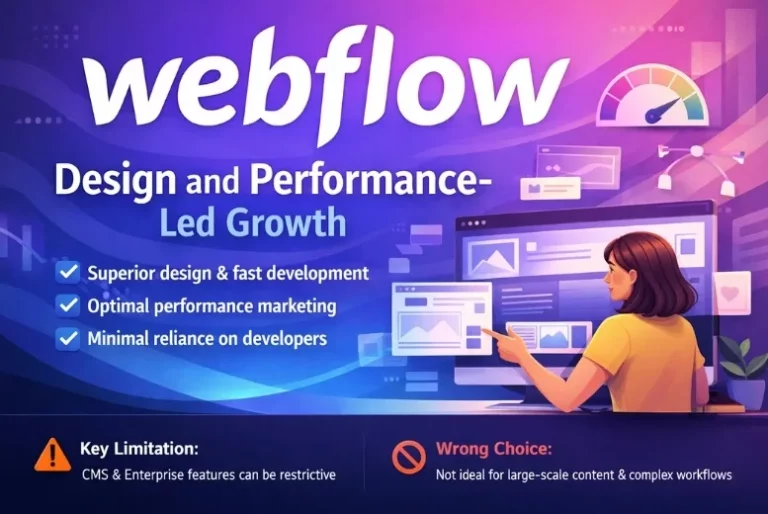
2. Webflow – Design and Performance-Led Growth
- Best for: Design-centric brands, marketing departments, conversion-oriented businesses.
- Webflow allows for superior design, optimal performance, and a rapid development process with minimal reliance on developers. It scales well for marketing experiences.
- Key limitation:
- With the increasing complexity of Content Models and workflows, the features provided by a CMS and Enterprise can be restrictive.
- When it becomes the wrong choice:
- If large-scale content architectures or complex workflows with strong backend functionality are required.
3. Shopify – Revenue-Led Growth
- Best for: Direct-to-consumer brands, subscription models, scaling e-commerce.
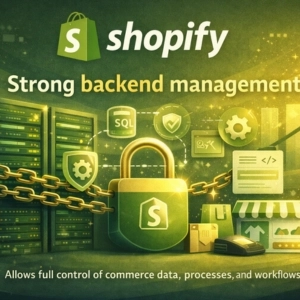
- Shopify gets rid of operational friction when using managed infrastructure, enhanced checkout, and commerce tools. It is the best solution for scaling revenue quickly.
- Key limitation:
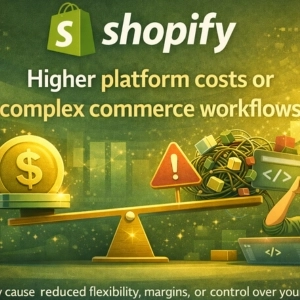
- Relatively less controlled backend and increasing costs of platforms may impact future flexibility and margins.
- When it becomes the wrong choice:
- When you have complex, customized commerce workflows or a need for complete control over your data or systems.
4. Framer – Speed-First Startup Growth
- Best for: Early-stage startups, MVPs, Product launches.
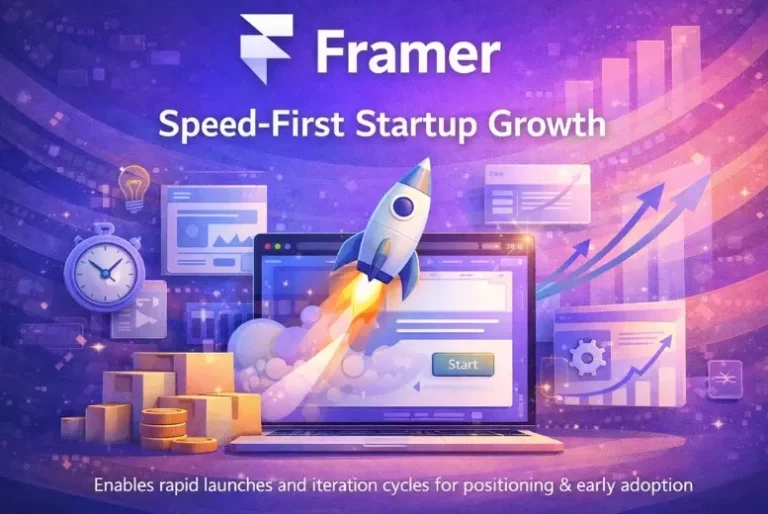
- Framer enables very fast launches and very fast iteration cycles. It is great for positioning tests and early adoption.
- Key limitation:
- Limited CMS depth and enterprise workflows are inadequate for long-term platform maturity.
- When it becomes the wrong choice:
- When high content updation, multiple teams, and workflows are complex work process.
5. Wix – Simplicity-First Growth
- Best for: Small businesses, single founders, and local brands looking to get online with minimal technical effort.
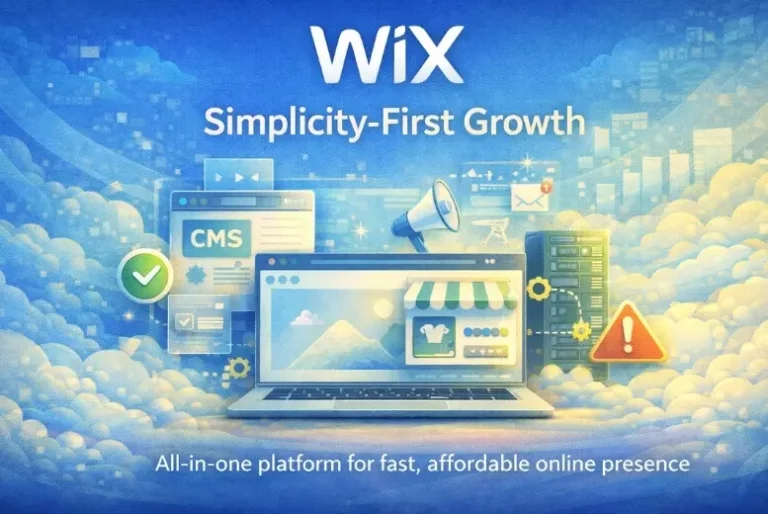
- Wix introduces an all-in-one simplicity platform, lowering the barrier to entry. Hosting, templates, CMS and basic marketing tools are bundled into one interface tool, meaning non-technical users can launch and manage sites independently from third-party help process. This translates for early-stage businesses into fast and affordable digital presence.
- Key limitation:
- Large ambitions grow SEO, scalability, and the flexibility of the back-end. Achieving more complex workflows, performance optimisation, and deeper integrations becomes increasingly challenging at scale.
- When it becomes the wrong choice:
- This occurs when SEO itself becomes one of the primary growth areas for your channels, when deep integrations are required, or when control over the platform becomes a strategic priority for long-term growth.
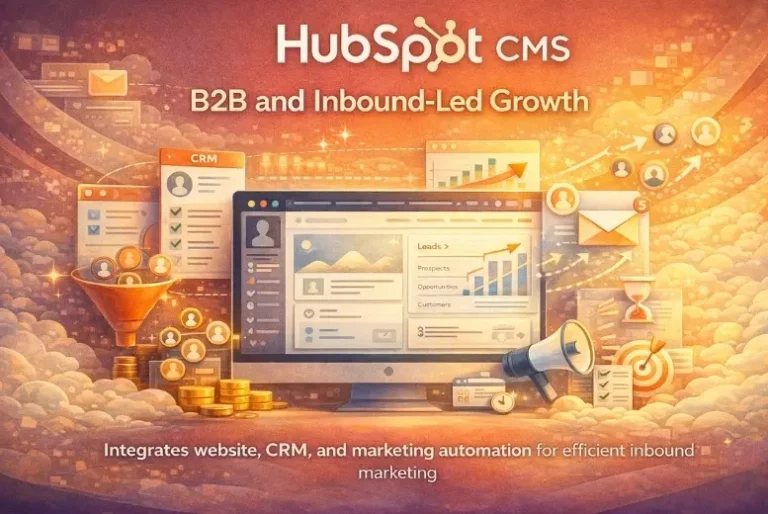
6. HubSpot CMS – B2B and Inbound-Led Growth
- Best for: B2B SaaS businesses, consultancies, and revenue-focused marketing teams in the case of lengthy sales cycles.
- The HubSpot CMS provides an integration of website, CRM, and marketing automation in one system. This offers very efficient personalization, lead nurturing and first-visit-to-close-deal visibility option. HubSpot is ideal for businesses practicing inbound marketing since this integration is a crucial way in which it maximizes sales efficiency and quality.
- Key limitation:
- Cost of subscriptions and a high degree of vendor lock-in may hinder architectural flexibility in the future.
- When it becomes the wrong choice:
- When there is a requirement for complete platform independence and when there is intense backend business logic to be implemented.
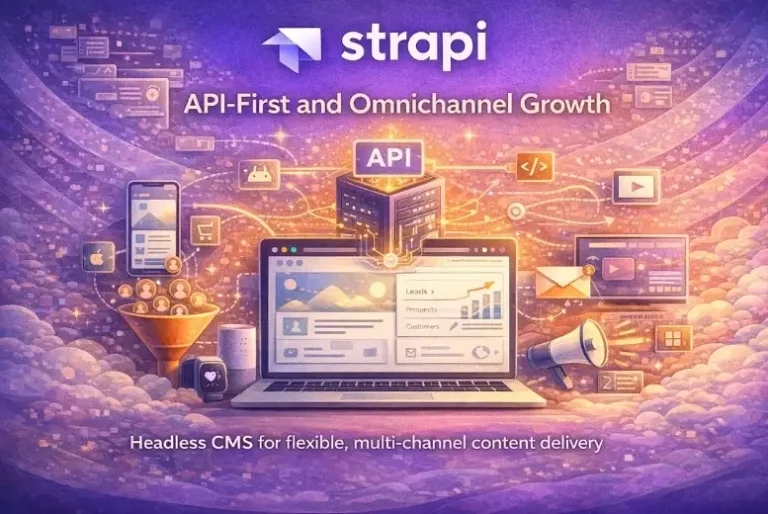
7. Strapi – API-First and Omnichannel Growth
- Best for: Product businesses and corporations creating multi-platform experiences in the web, mobile, and application spaces.
- Strapi allows a headless CMS function, API-based content delivery network, enabling content to serve multiple channels with high architectural flexibility. Hence, it caters to the needs of organizations that develop long-term, future-proof digital platforms.
- Key limitation:
- More operational complexity and high developer dependency translate into more infrastructure work.
- When it becomes the wrong choice:
- When designing simpler sites and prioritizing content and marketer efficiency over architectural flexibility.
A Real-World Decision Matrix
Instead of asking “Which CMS has more features?”, the better question is:
What is my primary growth priority right now?
- Fastest launch: Framer, Wix, Webflow
- SEO and content growth: WordPress, Webflow, HubSpot CMS
- E-commerce revenue: Shopify, Headless commerce
- Design and CRO: Webflow, Framer
- B2B lead generation: HubSpot CMS, WordPress + CRM
- Enterprise scale: Strapi, Hybrid enterprise stacks
This scenario-based approach reflects how real businesses make CMS decisions in 2026.
Hidden Factors Most Blogs Don’t Talk About
Most CMS failures happen because of hidden long-term risks, not missing features.
- Migration difficulty: How easy will it be to move later?
- Vendor lock-in: Who controls your platform over time?
- Maintenance cost: What is the real 5-year cost?
- Team dependency: Who becomes the execution bottleneck?
- Platform lifespan: Will this CMS still matter in five years?
Understanding these early can prevent costly rebuilds and technical debt.
CMS Trends That Will Impact Your Choice in 2026
Several trends are presently influencing decisions about CMS:
- AI Inside the CMS for Content, Personalization, & Optimization
- Headless and hybrid solutions going mainstream
- Platforms centered on performance, powered by Core Web Vitals
- Personalization as an expected default situation
- The responsibility for security and compliance shifting to a platform focus
A CMS that does not heed these trends will quickly date.
Final Decision Guide
Choosing the right CMS is not about deciding which is the most popular platform type. Instead, it is about finding the right platform for your current level of business and outlook.
For easy decision making, follow these four steps:
First, start by identifying your key objective — it may be traffic, revenue, lead generation, or flexibility offered by a platform.
Secondly, it is essential to be able to analyze the structure and skills within your teams so that you can understand how independently they must function.
Thirdly, plan in terms of a scale of CMSs every 3-5 years to match your business scale. Lastly, place your own identity in a matching category of CMSs as opposed to focusing on capabilities.
There is no such thing as “the best CMS website“, only “the best fit” based on your strategy and where you are.
Kleverway’s Recommendation Framework
At Kleverway, we start with business strategy, not tools.
We believe that CMS website choice should be determined by your plans for growth and not necessarily by what is trendy in the market. That’s why our first process is always understanding your plans for growth before we proceed to recommendations with respect to the use of technology.
Our approach is based on four easy principles:
- Business-oriented, not tool-oriented — our CMS strategies are shaped by your business model.
- Architecture that can scale with you — we use the best platforms to accommodate the growth of your business.
- Enabling teams, not bottlenecks - our priority is marketer-friendly and scalable processes.
- Long-term partnership, not a one-time setup — so much more than a launch and all about sustained growth.
Our aim is simple:
to turn your CMS into a growth asset, not an ongoing technical headache.

Jayamurugavel
SEO Executive | Technical SEO Specialist | 2+ Years Experience
Jayamurugavel is an SEO Executive at Creativenuts with hands-on experience in technical SEO, WordPress optimization, and performance marketing. He specializes in improving organic visibility, fixing core web vital issues, and generating qualified leads for business websites through data-driven SEO strategies.